
- Sun June 28, 2026|
 Alwasat FM|
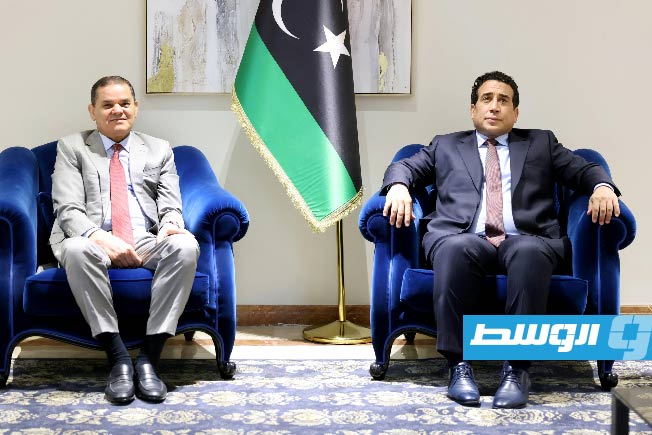
On Thursday, Presidential Council leader Mohamed Menfi welcomed the discussions at the Security Council session on Libya and the briefing by the Secretary-General’s Special Envoy to Libya, Hannah Tetteh, regarding government appointments and changes made outside constitutional and legal frameworks.
In a post on his X account, Menfi stated that these changes “set a precedent and opened the door to skepticism and legal challenges,” emphasizing that “any actions taken by the appointed ministers have no legal effect until they have taken the oath of office before the competent authority.”
On March 2, Menfi sent a letter to the head of the Government of National Unity, Abdulhamid Dabaiba, in which he affirmed that the government is a caretaker government, stressing that any ministerial reshuffle must be based on broad national consensus and legal frameworks, with mandatory consultation regarding the defense and foreign affairs portfolios.
However, he later approved the cabinet reshuffle on March 12 during a joint meeting attended by the President of the High Council of State, Mohamed Takala.
Who are the new appointees in Dabaiba's government?
After sovereign ministries were excluded from the reshuffle, notably the defense and foreign affairs portfolios, the list of new appointments in the government included: Salem Al-Zadma as Deputy Prime Minister, succeeding Ramadan Boujnah; Jamal Abuqrin as Minister of State for Displaced Persons; Mohamed Al-Ghouj as Minister of Health, succeeding Ramadan Boujnah; Salem Al-Alam as Minister of Culture, succeeding Mabrouka Tougi; and Nasr al-Din al-Fazani as Minister of Tourism.
Dabaiba also appointed Essam Jumaa as Minister of Housing, succeeding Abubakar Oweidat; Fouad Ahmed as Minister of Sports, succeeding Abdulshafi’ al-Jawfi, who took over the Ministry of Local Government; Ziad Abdulwarith as Minister of Industrial Intelligence; Muhammad Ali as Minister of Industry; and Haitham Youssef as Minister of Youth, succeeding Fathallah al-Zani; Husni Oweidan as Minister of Water Resources; Muhammad al-Dabib as Minister of Higher Education, succeeding Amran al-Qayb; Suhail Boushiha as Minister of Economy, succeeding Muhammad al-Huweij; and Randa Gharib as Minister of Women’s Affairs, succeeding Houria Tarmal.
Tetteh Comments on the Cabinet Reshuffle
During her briefing to the UN Security Council on Wednesday, Teteh said the mission had been informed that Dbeibeh began a process of appointments on March 3, which included about 21 ministers and deputy ministers over roughly two weeks, expanding the Cabinet to 32 ministers.
She said that “all appointments must respect the provisions of previous Libyan political agreements if they are to serve the goal of unifying the country.”
Tetteh emphasized the need to resolve differences between the parties and unify all state institutions, calling on the Libyan parties to implement legislative reforms as outlined in the recommendations of the Advisory Committee and the Structured Dialogue, following its conclusion next June.



Comments