
- Thu June 25, 2026|
 Alwasat FM|

The UN Panel of Experts on Libya discussed how Libyan territory has become a platform for supporting Sudan’s “Rapid Support Forces” and for transporting weapons and mercenaries via smuggling routes to the south, creating far-reaching security and regional repercussions.
In the draft report covering the period from October 2024 to February 2026, the panel stated that armed groups in eastern and southern Libya have been transporting mercenaries from Colombia, as well as weapons, military equipment, and fuel, to Sudan for the Rapid Support Forces, some of whose members are present within Libyan territory.
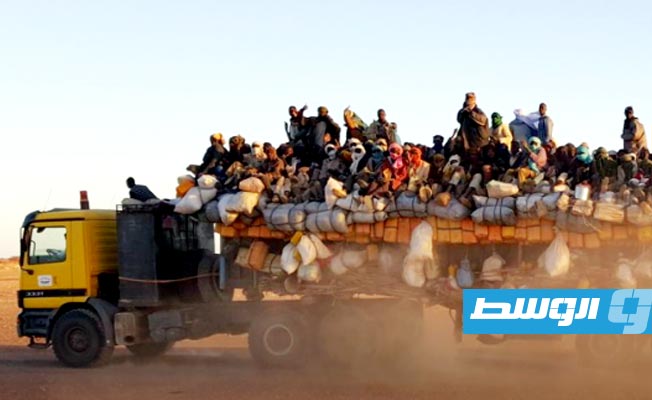
The report noted that “armed groups in eastern Libya have profited from the proceeds of cross-border smuggling activities, particularly the smuggling of fuel, weapons, and mercenaries.” It described the city of Kufra as “a hub for transporting weapons and mercenaries southward to Sudan,” given its proximity to the border and smuggling routes.
The “Subul al-Salam” Battalion and Smuggling Routes
The draft report, reviewed by Alwasat stated that “Between January 2025 and January 2026, the Subul al-Salam Battalion and its commander, Abdulrahman Hashim, increasingly consolidated their control over the supply chains used to transport fighters, weapons, and military equipment from Libya to the Rapid Support Forces in Sudan.”
It added that “this control, along with its tribal ties, enabled the group to use multiple routes to support the Rapid Support Forces. The Subul al-Salam Battalion and its counterparts in the Rapid Support Forces took turns using these routes, while maintaining parallel logistical routes to ensure the continuity and efficiency of the transport of fighters, fuel, weapons, and related equipment in a coordinated and centralized manner.”
The report accused the “Subul al-Salam Battalion of exercising complete control over the key logistical, security, and facilitation components necessary to support the transport of fighters, fuel, weapons, and related equipment, including military vehicles.”
It noted that since June 2025, Subul al-Salam has supported the Rapid Support Forces by “deploying units on the ground, providing fighters and escorting them across Libyan territory, and facilitating their access to fuel and vehicle spare parts, which was evident in the Rapid Support Forces’ advance in the Al-Awinat area.”
Continuous Flow of Weapons to Sudan
The panel spoke of a continuous flow of illicit weapons from Libya to Sudan, “which has created a parallel market for the transfer of weapons, military equipment, and fuel to the Rapid Support Forces, and the redirection of those goods to local markets within Libya, Chad, and Niger, thereby contributing to the entrenchment of a war economy along the country’s southern border.”
The panel documented one instance in which “ammunition intended for the Rapid Support Forces was diverted and resold to individuals involved in gold smuggling in Niger” linked to the Islamic State.
The experts also noted the presence of Rapid Support Forces elements inside Libya during the period covered by the report, which resulted in armed clashes between Sudanese parties within Libyan territory, particularly in June and November of last year.
Facilitating the Arrival of Mercenaries in Sudan
In a related context, the report noted the use of Libyan territory to transport mercenaries of various nationalities to participate in the civil war in Sudan. It stated that “the Subul al-Salam Battalion worked to transport mercenaries from Colombia to fight alongside the Rapid Support Forces in Libya. The city of Kufra served as a central transit point” .
The report described Libya as having “become an operational, logistical, and tactical base,” which has amplified the dynamics of regional repercussions. It stated that in the first half of November 2025, “the Sudanese Armed Forces launched airstrikes targeting convoys of vehicles and foreign fighters on Libyan territory, in an attempt to disrupt the supply chains supporting the Rapid Support Forces.”
Experts: Presence of mercenaries from Syria at several locations in the western region
In the western region, the experts noted a continued presence of mercenaries from Syria during the period covered by the report.
“Fighters from Syria were deployed to several locations in Tripoli, including the Tekbali camp, the Salah al-Din camp, the Abu Salim area, and the Yarmouk military base, as well as Misrata.”
The report claimed that “Syrian mercenaries participated in armed clashes during the events of May 2025.” As tensions escalated, armed groups based in Tripoli mobilized Syrian fighters to bolster their military operations, reflecting a continued reliance on foreign fighters as a reserve force ready for deployment in times of crisis.”
In eastern and southern Libya, the panel documented “the presence of Syrian fighters at strategic military sites, including the recently upgraded Maatin al-Sarra Air Base.”
The report also tracked illicit fuel smuggling activities to Sudan via southern Libya, with sporadic shipments also reaching Somalia, Port Sudan, and Sudan, some of which were bound for South America, Syria, Turkey, and the United Arab Emirates.




Comments